
Connective tissue turns into gelatine
Also searched as: collagen, connective tissue, braising makes tender, slow braising
In short: Tough connective tissue dissolves into gelatine in long, moist heat. That is why braising cuts turn meltingly tender after hours.
Like a tightly knotted rope that slowly swells and loosens in warm water: force does not work, only time.
Simplified model
Temperature thresholds
3
- 70 °Cconnective tissue starts to dissolve
- 85 °Cideal for braising
- 100 °Cbubbling: fibres dry out
Below 70 °C none of this happens yet. From 70 °C: connective tissue starts to dissolve.
What happens
Connective tissue is made of collagen, very tough protein ropes. From about 70 °C they start to dissolve, but only slowly and best in a moist setting. They turn into gelatine, which can bind a lot of water and makes the meat seem juicy. The hotter, the faster, but too much heat squeezes out the muscle fibres.
Why it matters
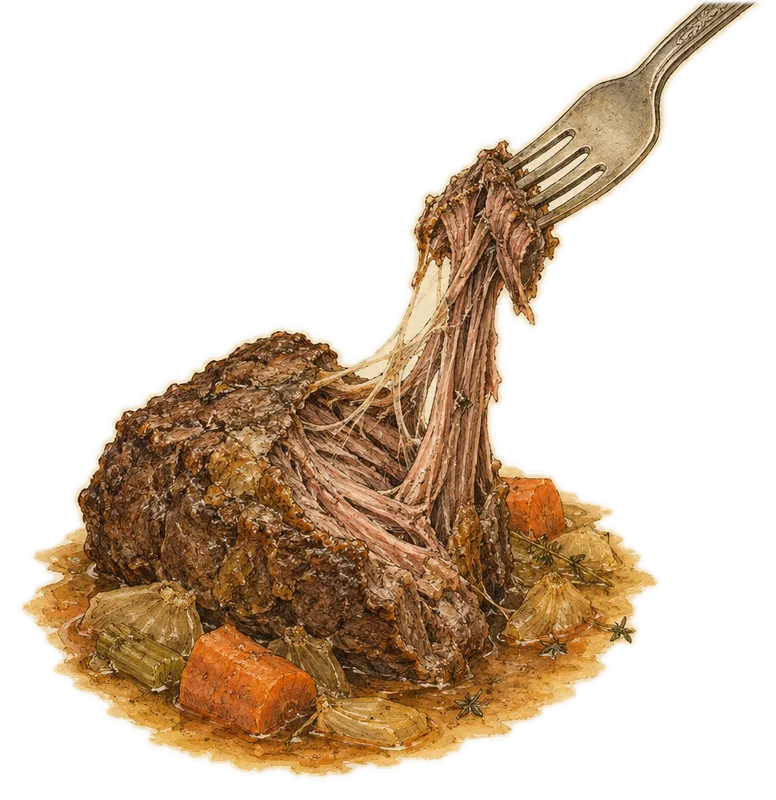
Explains why shoulder, shin or cheek are tough when quickly fried and wonderfully when braised.
Rules of thumb
- Let the liquid barely simmer, not boil.
- In a pot at about 85–90 °C, count on 2–3 hours; in a slow cooker, 6–8.
- It is done when a fork slides in without resistance, not when the clock says so.
Levers
3
Common mistakes
1
- Taking braised meat out of the pot too early: it is then tougher than at the start.
In practice
2
Meat
Ragù, pot roast, boiled beef: cuts with lots of connective tissue need hours rather than minutes.
Sauces
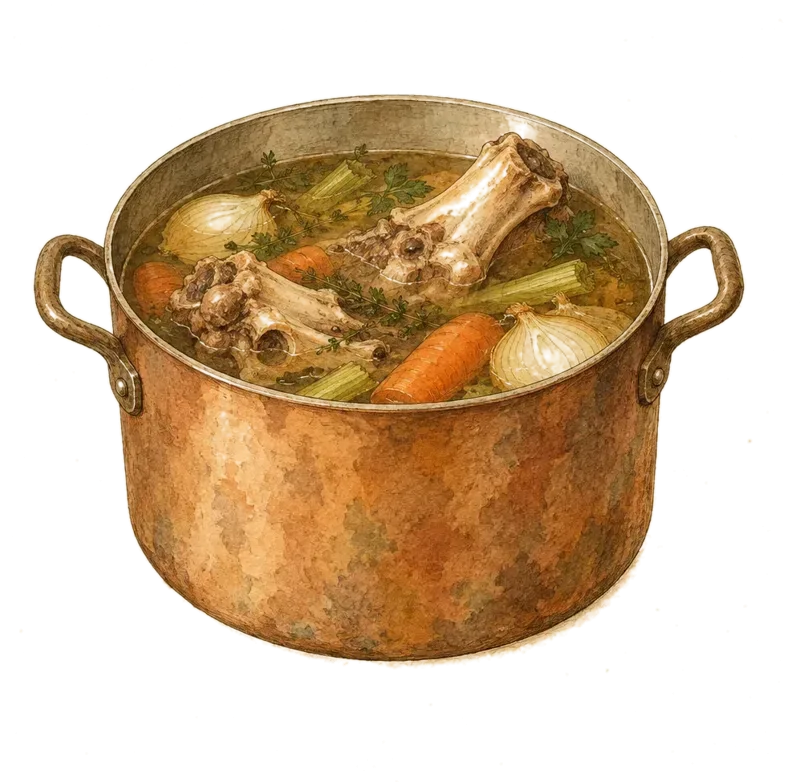
Simmered bones release gelatine into the stock. Cold it sets; warm it makes sauces silky.
 Meat is tough
Sources · 3
- Ricardo: How to perfect the art of braising
- ThermoWorks: How Meat Cooks – Heat’s Effects on Muscle Fibers
- Harold McGee: On Food and Cooking (2004), Kapitel Fleisch